
A recent Spring 2024 issue of the California Bountiful magazine, features Nutrition Policy Institute's collaborative research with Impact Justice and ChangeLab Solutions on their Farm to Corrections California project. The article titled, “Program benefits inmates, small farms and local economies,” by Linda DuBois highlights the initiative created from the project, “Harvest of the Month.” This initiative supports local agriculture and nutrition promotion, individual well-being, and equitable access to fresh, diverse food options within the California Department of Corrections and Rehabilitation state prisons. Learn more about the program in this news story.

Research for healthy food, people and places
The Nutrition Policy Institute (NPI) envisions a world in which healthy food, beverages and opportunities for physical activity are accessible, affordable, equitable and sustainable for everyone.
NPI's mission is to conduct and translate policy-relevant research to transform environments for healthy children, families and communities.
Read more about our mission and vision, and learn about our impact.
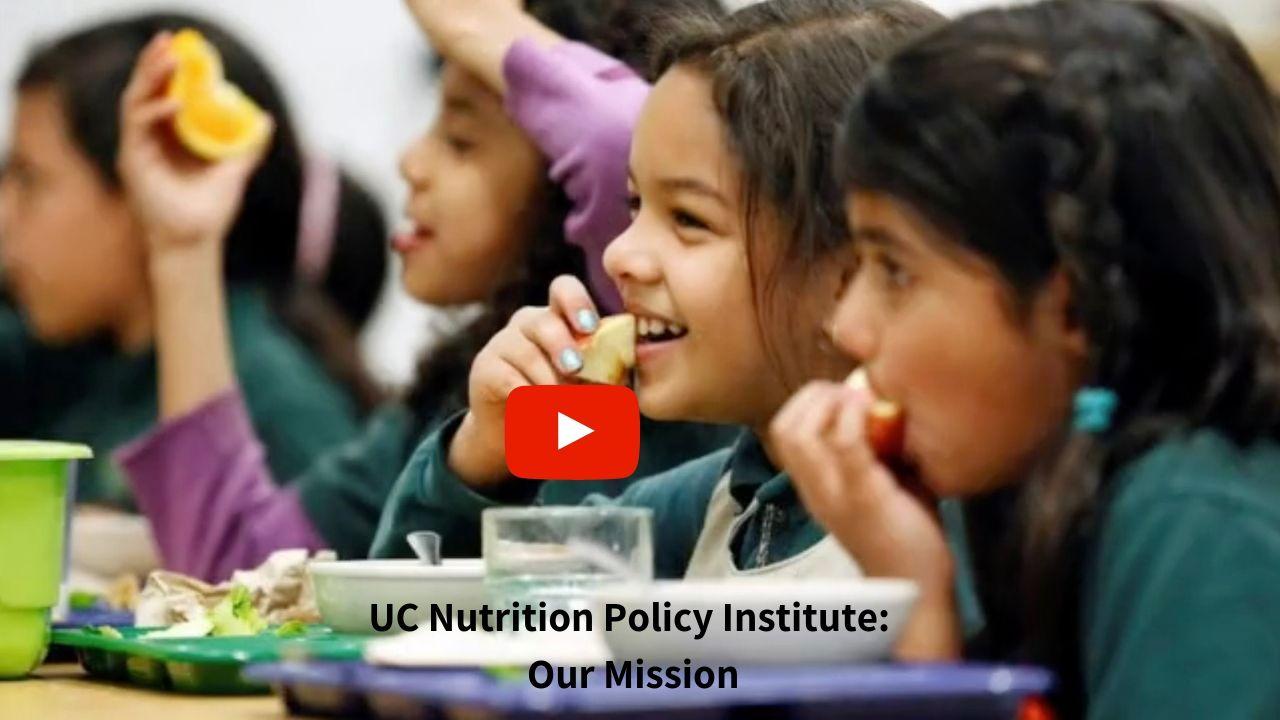
This video is also available in Spanish.
You can now contribute to the work of NPI by making a tax-deductible donation. Your gift will help reduce food insecurity, obesity and diabetes by ensuring that healthy food, beverages and opportunities for physical activity are convenient, accessible, affordable and sustainable.
News Brief Sign-Up
Sign up to receive Research to Action, the Nutrition Policy Institute's quarterly news brief providing information on research, policy, news, announcements, events, articles and action items focused on nutrition and healthy communities.
News
-
California Bountiful Magazine features Nutrition Policy Institute’s collaborative Farm to Correction project
Apr 16, 2024
-
New report shares perspectives from over 38,000 WIC participants in 21 states
Over 38,000 participants in the federal Special Supplemental Nutrition Program for Women, Infants and Children, commonly known as WIC, completed a satisfaction survey in summer of 2023. Conducted across 21 participating WIC state agencies in all US Department of Agriculture administrative regions, the survey showed high satisfaction with the WIC program and that participants feel respected, valued and included by WIC staff. The hybrid WIC services introduced during the pandemic were successful, with two-in-three using in-person services, over half using remote services and nearly all finding it is easy to schedule appointments. The top reasons for WIC participation were the fruits and vegetables in the WIC food package followed by other foods and the education and support from WIC staff. Participants expressed interest in using WIC benefits at farmers markets and requested expanded fruit and vegetable options in states that don't authorize canned or frozen options. The survey illuminated challenges participants experience when shopping for WIC foods, reasons for not buying all their WIC foods, and their desire for expanded shopping options. Results align with the recently finalized WIC food package changes. Findings are available in the report “2023 WIC Multi-State Participant Satisfaction Survey” published online on April 9, 2024. The project was conducted by Lorrene Ritchie, Danielle Lee, Celeste Felix, Ken Hecht and Hannah Thompson from the Nutrition Policy Institute, Loan Kim, Theresa Tran, Claire Burton and Amanda Kiang from Pepperdine University and Georgia Machel from the National WIC Association. The project was funded by the National WIC Association through a grant from the Robert Wood Johnson Foundation.
-
Study examines sociodemographic factors in multi-program take-up of safety net programs among California families
US safety net programs provide aid to low-income households through cash and in-kind assistance, such as food and healthcare benefits. Using data from the Assessing California Communities' Experiences with Safety Net Supports ACCESS,study researchers examined patterns of multi-program take-up, that is participation conditioned on eligibility in California. Sociodemographic factors associated with multi-program take-up were also identified. Among the four safety net programs examined (i.e., Earned Income Tax Credit or EITC, the Supplemental Nutrition Assistance Program or SNAP, the Special Supplemental Nutrition Program for Women, Infants, and Children or WIC, and Medicaid), NPI researchers found relatively low multi-program take-up of SNAP and WIC. Meanwhile, the take-up of Medicaid was high, both as an individual program and among those participating in other programs. Sociodemographic factors, including Income, age, and primary language spoken were associated with multi-program take-up. To improve multi-program participation, study researchers recommend streamlining application processes to reduce administrative burden, data sharing among safety-net programs, and targeted recruitment of under-enrolled subgroups. Increasing multi-program take-up of safety net programs among California families can contribute to improved health equity and address key social determinants of health. This study was conducted by NPI researchers Marisa Tsai and Wendi Gosliner, Joseph Yeb with Tufts University School of Medicine, Kaitlyn Jackson and Rita Hamad with Harvard School of Public Health, and Lia Fernald with the University of California Berkeley, School of Public Health.
-
High support exists among parents of all income levels for School Meals for All in California
In a recent research brief, Nutrition Policy Institute researchers highlight the benefits of California's School Meals for All program which offers breakfast and lunch to all K-12 students at public and charter schools every instructional day, at no charge, regardless of household income. The program began in the 2022-2023 school year after temporary federal pandemic funding for universal meals ended. Prior to the pandemic, household income determined school meal charges. The brief shares findings from a 2023 NPI survey examining parents' perceptions regarding the policy's impact. Among a diverse representation of all income levels and ethnic groups, 80% of all parents were in support. Christina Hecht, NPI's senior policy advisor, presented these findings and other NPI research on School Meals for All to the California State Assembly Budget Subcommittee on Education Finance on Wednesday, March 20, 2024. In her public testimony, Hecht explained that “...65% of parents across all income levels believe the School Meals For All program reduces stigma for their child about eating a school meal.” Findings can inform further efforts to continue the expansion of California's School Meals For All program to reduce financial strain, food insecurity, stress, and stigma among families. The research was led by Dania Orta-Aleman, Christina Hecht, Monica Zuercher, Ken Hecht, Samantha Sam-Chen, Lorrene Ritchie, and Wendi Gosliner from NPI and Juliana Cohen from Merrimack College.
-
NPI welcomes KC Whitsett as new project policy analyst
KC Whitsett joined the Nutrition Policy Institute at the University of California, Agriculture and Natural Resources on March 25, 2024, as a project policy analyst. Originally from Virginia, KC earned a BS in Kinesiology and Health Sciences from the College of William & Mary. KC also holds a Master of Public Health from UC Berkeley, with an interdisciplinary concentration on research and evaluation methods for food access and nutrition programs. Her previous professional experiences include program and grant management and community health education. She has expertise in the evaluation of physical activity and food access programs—healthy corner store initiatives, mobile markets, SNAP incentives—and farmworkers' access to health care services. In her role at NPI, KC will support qualitative data collection and analysis for projects related to school meals, the Child and Adult Care Food Program and the Special Supplemental Nutrition Program for Women, Infants and Children—commonly known as WIC.
Topics: -
NPI receives funding to conduct a research project on milk-fat content effects on toddler health
Milk provides various nutrients such as calcium, protein, and vitamin D, which are essential for health and brain development. In the US, it is advised that children switch from the recommended whole cow's milk from ages 1-2 to low-fat or non-fat milk after age 2 to reduce saturated fat and calorie intake, however, few studies support this recommendation. Nutrition Policy Institute researchers and Anisha Patel with the Stanford Medicine Department of Pediatrics recently received funding for a research study from the National Institute of Health. The study, Milk Type in Toddlers or Milk-TOT, includes a randomized controlled trial that will investigate how whole and low-fat 1% milk affect child adiposity, dietary intake, and health outcomes, aiming to provide evidence-based recommendations for dietary guidelines. The California Dairy Research Foundation provided additional funding to include the assessment of the impacts of varying milk types on participating children's gut microbiota diversity, in collaboration with Justin Sonnenburg with the Stanford Medicine Department of Microbiology and Immunology. Parents or caregivers with children between 23-30 months old living in the San Francisco Bay Area may be eligible to participate in the study. The four-year project began in January 2024 and is estimated to end in June 2028. The project is led by Lorrene Ritchie as the principal investigator, and NPI researchers, Kassandra Bacon, Ryan Williams, Suzanne Rauzon, Celeste Felix, Hannah Thompson, Fanta Jimissa, Reka Vasicsek and Meirong Liao.
-
Research brief examines benefits of Massachusetts’ Healthy School Meals for All policy on families
A recent research brief from researchers at Merrimack College and the Nutrition Policy Institute highlights the impact of the Massachusetts Healthy School Meals for All policy on families. The policy was implemented in 2022, aiming to alleviate financial burdens for families by providing free school meals for all students. A sample of 284 parents selected to be representative of the state completed a survey, revealing strong support for the policy across all income brackets. Families reported numerous benefits of the policy, including financial savings, time efficiency, and reduced stress as well as improved student behavior and academic achievement. Moreover, survey results demonstrated that if the policy ended, parents believe there would be an increase in the stigma associated with receiving meal assistance which could prevent some children from consuming school meals. This research brief helps support the continuation of the Healthy School Meals for All policy as well as future efforts to expand access to nutrition programs in schools. This research brief was developed by Juliana Cohen with Merrimack College and the Harvard T.H. Chan School of Public Health, Nutrition Policy Institute researchers Wendi Gosliner, Christina Hecht, Ken Hecht, Monica Zuercher, and Lorrene Ritchie, and Marlene Schwartz from the University of Connecticut Rudd Center for Food Policy and Health, and. This research was funded by The Robert Wood Johnson Foundation Healthy Eating Research and Project Bread.
-
NPI welcomes Caitlin French as new Assistant Project Scientist
Caitlin French joined the Nutrition Policy Institute at the University of California, Agriculture and Natural Resources on March 1, 2024 as an Assistant Project Scientist. Caitlin earned her PhD in Nutritional Biology with an emphasis in Global Nutrition from UC Davis. Her previous and current research endeavors focus on dietary analysis methods, dietary biomarkers, and evaluating the impacts of nutrition programs, such as produce prescriptions and the Special Supplemental Nutrition Program for Women, Infants and Children, commonly known as WIC. Her primary research interests center on informing policies and programs that aim to achieve equity in access to healthy foods and environments and to reduce diet-related chronic diseases. In her role at NPI, she will support the evaluation of California's Universal School Meals Program.
-
California Agriculture publishes NPI-led special issue on lessons learned during COVID-19
California Agriculture, the University of California Agriculture and Natural Resources research journal, has published a special issue on lessons learned from the COVID-19 pandemic to inform Cooperative Extension programming and local, state, and federal policy to improve population health, food security, economic resilience, equity, and sustainability throughout the state and food system. The special issue was developed by Nutrition Policy Institute director, Lorrene Ritchie alongside Marcel Horowitz a UC Cooperative Extension community nutrition and health advisor, and Gail Feestra, UC ANR emerita and the former UC Sustainable Agriculture Research and Education Program director. Published in December 2023, the issue includes nine articles on studies conducted within the first two years of the pandemic. The articles emphasize the importance of infrastructure investments and offer new strategies to improve resilience in the face of future challenges, based on results found during COVID-19. The issue includes a published research article on the results of school meal consumption during COVID-19, written by Nutrition Policy Institute researchers, Kaela Plank, Amanda Linares, Sridharshii Hewawitharana, and Gail Woodward-Lopez.
-
Study examines associations among participants in safety-net programs with government perceptions, welfare stigma, and discrimination
Safety net programs such as the Supplemental Nutrition Assistance Program, known as SNAP nationally and CalFresh in California, and the Earned Income Tax Credit, commonly known as EITC, provides great benefits to families facing economic hardship and food insecurity. However, participation in these programs was lower in California compared to the national average. Nutrition Policy Institute researchers examined the associations of participation in SNAP and receipt of the Earned Income Tax Credit with perceptions of government, welfare stigma, and discrimination among families in California with low incomes. Researchers conducted a cross-sectional survey and interviews involving 497 caregivers of young children in California between August 2020 and May 2021. Study results highlighted that SNAP participants and EITC recipients had greater perceptions of social stigma compared to eligible non-participants in these programs in the beginning of the pandemic. Further, SNAP was associated with program stigma and experiences of discrimination among food-insecure participants. This study suggests that reducing stigma related to safety net program participation is important, and policymakers should consider initiatives to improve messaging and outreach that may help. The study was recently published in the Health Affairs Scholar journal. This study was conducted by Nutrition Policy Institute researchers Richard Pulvera and Wendi Gosliner, along with Kaitlyn Jackson and Rita Hamad of Harvard T.H. Chan School of Public Health, and Lia Fernald with the School of Public Health, University of California Berkeley.